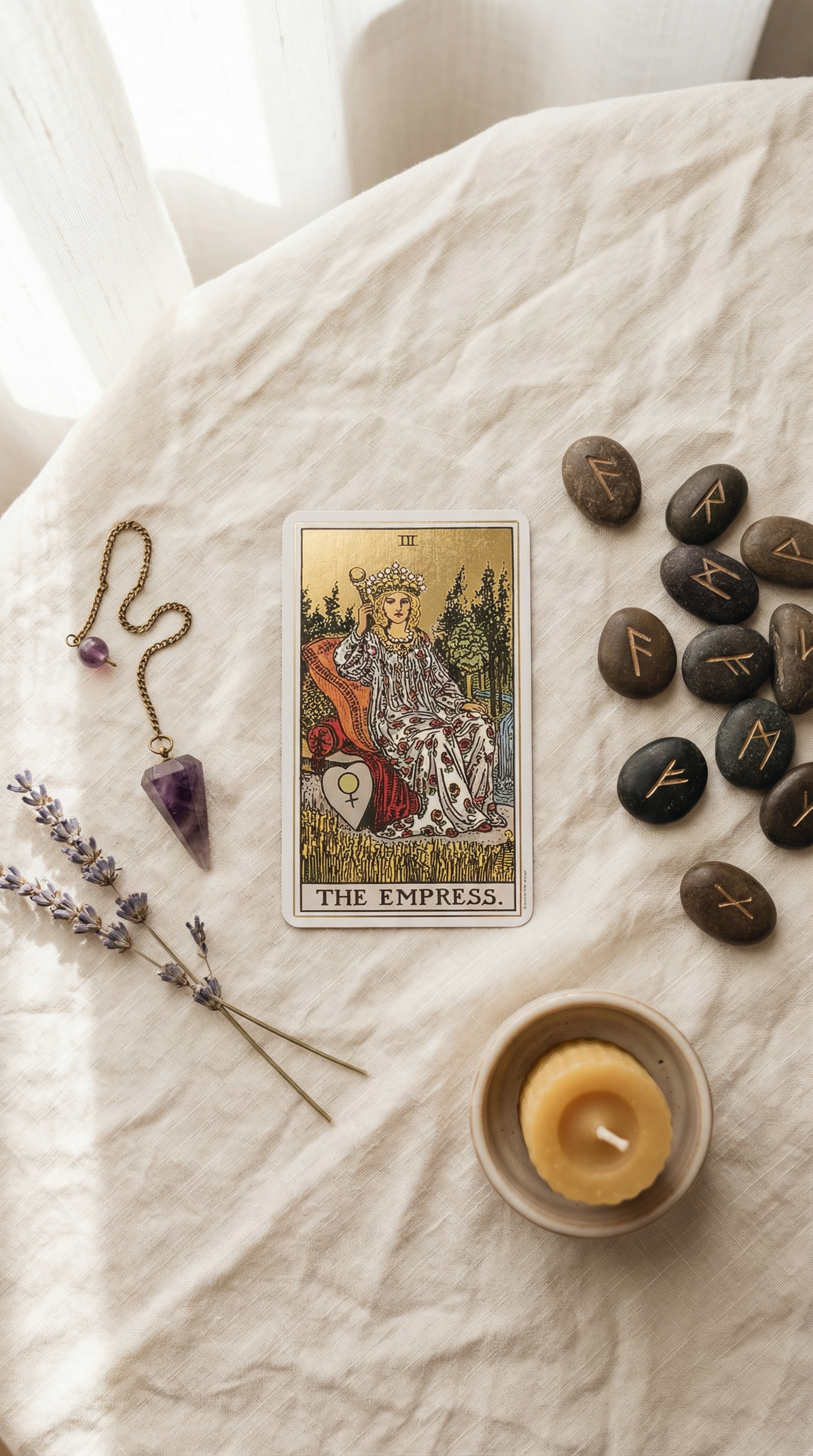
Divination is one of those words that can feel intimidating before you actually try it. It sounds ancient and formal, like something that requires years of study before you’re allowed to touch a deck. The truth is much simpler: divination is just a practice of asking questions and listening. The tool you use is really just a way to slow down and tune in.
If you’ve been curious about divination but aren’t sure where to start, you’ve probably already noticed the problem: there are a lot of options. Tarot decks. Oracle cards. Pendulums. Runes. Scrying mirrors. Tea leaves. The list keeps going, and none of them come with a clear label that says “start here.”
The good news is that there’s no universally correct first tool. The better news is that figuring out which one is right for you is actually pretty straightforward once you stop trying to choose the “best” one and start paying attention to what already pulls at you.
What Divination Actually Is (And Isn’t)
Divination is the practice of seeking insight or guidance through symbolic systems. It isn’t about predicting a fixed future. It’s about creating a conversation between you and your own deeper knowing, using symbols, images, or signs as the language.
That means the tool itself matters less than you might think. What matters more is whether you feel a genuine draw toward it, whether you’ll actually use it, and whether it opens something up in you when you sit with it.

The Five Most Common Starting Points
Before you choose, it helps to understand what each tool actually asks of you.
Tarot is a 78-card deck with a structured system: 22 Major Arcana cards representing big life themes and 56 Minor Arcana cards covering everyday experiences. It has a learning curve. There’s real depth here, and if you love symbolism, storytelling, and the satisfaction of a system you can study, tarot tends to reward that kind of person enormously. Your first spread can be as simple as a single card pulled in the morning.
Oracle cards are looser and more intuitive. Unlike tarot, oracle decks don’t follow a fixed structure, so every deck is its own world. Some are word-based, some are image-based, some are deeply spiritual and some are playful. If the idea of memorizing a system feels overwhelming, oracle cards are often a gentler entry point. You read them more by feel than by rule.
Pendulums are simple weighted objects on a chain or cord that respond to yes or no questions through subtle movement. They’re excellent for people who want quick, direct answers and who trust their body’s intuitive responses. A pendulum doesn’t require any prior knowledge, just a willingness to ask questions and pay attention.
Runes are an ancient Germanic alphabet used for divination by drawing or casting stones or tiles marked with symbols. There are 24 symbols in the Elder Futhark system, each carrying a range of meanings. Runes tend to appeal to people who are drawn to earth-based or ancestral magic, or who find card-based divination too visually busy.
Scrying is the practice of gazing into a reflective or translucent surface, such as a mirror, a bowl of water, or a crystal ball, to receive impressions or visions. It’s more open-ended and intuitive than any of the above. If you’re highly visual and naturally slip into meditative states, scrying might speak to you. If you need structure, it might frustrate you.

How to Actually Choose
Rather than researching your way to a decision, try this instead.
Notice what you were drawn to before you started reading this post. That pull usually means something. If you’ve been eyeing tarot cards for years but talked yourself out of it, that’s information.
Think about how you naturally process things. Do you like systems and depth? Tarot or runes. Do you prefer intuition over analysis? Oracle cards or scrying. Do you want quick, clear answers? Pendulum.
Consider your lifestyle. A tarot practice asks more of you upfront than a pendulum does. That’s not a judgment, it’s just a practical consideration. The best tool is the one you’ll actually return to.
You don’t have to commit forever. You can start with one tool, explore it for a few months, and add others as your practice deepens. Many practitioners use multiple tools for different purposes.

A Note on Buying Your First Deck or Tool
You may have heard that you should receive your first tarot deck as a gift rather than buy it yourself. This is a beautiful tradition, but it’s just that: a tradition, not a rule. Buy your own deck if you want to. Choose it yourself. The magic comes from how you use it, not how it arrived.
When choosing a tarot or oracle deck, look for one whose imagery genuinely moves you. You’ll be spending a lot of time with these images. If you feel nothing when you look at the cards, keep looking.
For pendulums and runes, trust the same instinct. Something simple and inexpensive is a perfectly valid starting point. You can always expand later.
A Few Beginner-Friendly Oracle Decks Worth Knowing
If you want a starting point rather than an open-ended search, here are three that consistently come up as genuinely accessible for beginners:
The Work Your Light oracle is warm and emotionally intelligent. Rebecca Campbell’s guidebook is generous and encouraging. It’s a good companion for journal work and self-reflection.
The Moonology oracle is an excellent choice if you’re already paying attention to moon phases. Each card connects to a specific lunar energy, making it easy to layer into a practice you’re already building.
The Good Tarot deck is a great place to start is tarot feels overwhelming to you or you’re nervous about interpreting the messages negatively.
Starting Small Is Starting Right
You don’t need a full ritual to begin. Pull one card in the morning and sit with it for a few minutes. Ask your pendulum one question and notice the response. Hold your rune stones and draw one when you need clarity.
The relationship you build with your divination tool develops over time, through use, not through research. The best way to choose is to choose, and then begin.
Ready to take it further? The Intro to Channeled Writing 30-Day Challenge teaches you how to receive guidance directly.


Leave a Reply