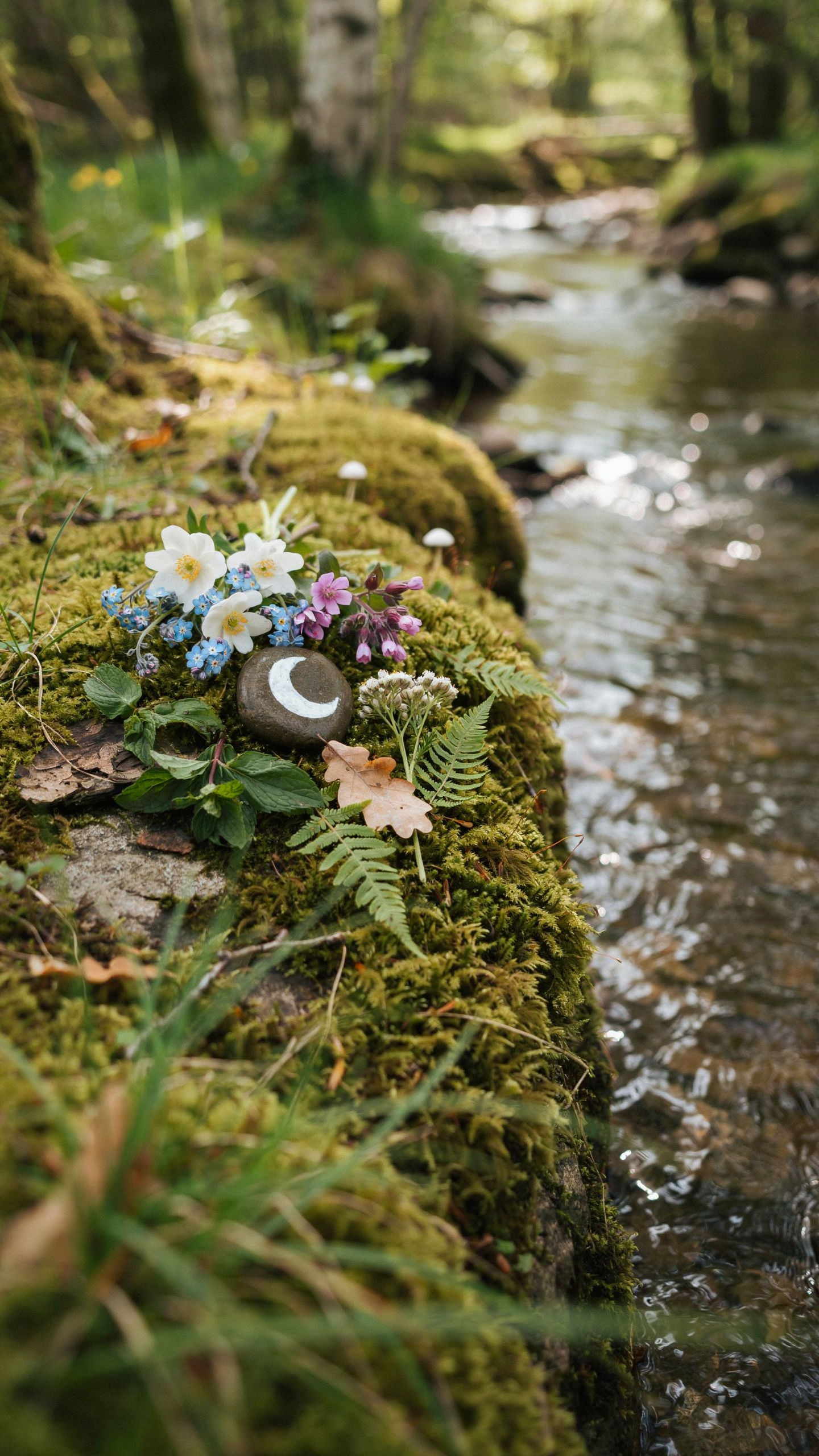
The world is not as empty as it looks. In almost every spiritual tradition across every culture and continent, people have understood that the natural world is inhabited, not just by plants and animals and insects, but by presences. Spirits. Intelligences woven into the land, the water, the wind, and the fire. This post is your deep-dive introduction to the nature spirits witches work with, what they are, where they come from, and how to understand them.
Why Nature Spirits Matter in Witchcraft
Modern witchcraft draws heavily from animist roots, even when practitioners don’t use that word. Animism is simply the understanding that the world is alive with spirit, that trees and rivers and stones and storms have their own kind of consciousness or presence, and that relationship with the natural world is reciprocal rather than extractive.
When you leave an offering at the base of a tree, whisper a request to the wind, or feel the pull of a particular place in the forest, you are operating within an animist framework whether you realize it or not. Nature spirit work makes that framework explicit. It asks you to move through the world with the assumption that you are never alone in it, that the places and elements around you have their own agency and their own wisdom.
This is also some of the oldest magic there is. Long before grimoires and ceremonial traditions and formalized witchcraft, humans were in relationship with the spirits of their local landscape. That relationship is available to you too.
A Note on Approaching This Work
Nature spirits are not tools. They are not automatically friendly, and they are not obligated to help you. Different traditions have very different understandings of what these beings are, what they want, and how to approach them respectfully.
As you read through this guide, hold these things:
Most nature spirit traditions emphasize reciprocity. You give before you ask. You tend the relationship before you make a request. You approach with respect and genuine interest rather than an agenda.
Not all nature spirits are interested in human contact. Some are indifferent. Some are territorial. Some are actively mischievous or dangerous. Discernment matters.
Your local landscape matters more than any book. The spirits of your particular land, your specific forest, the creek that runs behind your house, are more relevant to your practice than mythological beings from a tradition that isn’t yours. Start close. Start local.
With that said, let’s get into it.

The Fae
What Are the Fae?
The fae (also called the Fair Folk, the Good Neighbors, the Hidden People, the Gentry, and dozens of other euphemistic names) are one of the most complex categories of nature spirit in European folklore. They are not the tiny flower-dwelling creatures of Victorian illustration. In older traditions, the fae are powerful, unpredictable, morally ambiguous beings who occupy a world adjacent to the human one, sometimes visible, sometimes not, sometimes helpful, sometimes deeply harmful.
The fae are most thoroughly documented in Irish, Scottish, Welsh, and broader Celtic folklore, though analogous beings appear across Norse, Slavic, Germanic, and many other traditions. Their exact nature is debated even within the traditions they come from. Are they the spirits of the dead? Ancient gods who diminished over time? Elemental beings? Residents of a parallel world? Different traditions answer this differently, and many don’t answer it at all.
What most traditions agree on: the fae are not human, they operate by different rules, and the relationship between humans and fae requires careful navigation.
The Sídhe (Irish and Scottish Gaelic Tradition)
The Sídhe (pronounced “shee”) are the fae of Irish and Scottish tradition, often understood to be the Tuatha Dé Danann, the ancient divine beings of Ireland who retreated into the hollow hills (the sídhe mounds) when humans took dominion over the land. They are not small or delicate. They are tall, luminous, powerful, and deeply associated with specific places in the landscape.
The sídhe mounds, also called fairy mounds or fairy hills, are real places in Ireland and Scotland, ancient burial mounds and earthworks that were understood to be the thresholds between the human world and the realm of the fae. These places were treated with enormous respect and a certain amount of fear. Disturbing a fairy mound was understood to invite serious consequences.
The Sídhe include a number of specific beings worth knowing:
The Aos Sí is the broader category name for the spirit people of the mounds, the fae as a collective.
The Bean Sídhe (Banshee) is a female spirit attached to specific Irish families whose keening wail is heard before a death. She is not malevolent so much as she is a messenger of fate, deeply connected to the ancestral bloodline she watches over.
The Leannán Sídhe is a fae muse, often depicted as a beautiful woman who inspires human artists and poets in exchange for their life force. The relationship is seductive and ultimately costly. She is one of the more clearly dangerous fae figures in Irish tradition.
The Cú Sídhe are fae hounds, large and often described as green or white, associated with hunting, death, and the transition between worlds.
The Tylwyth Teg (Welsh Tradition)
The Tylwyth Teg (pronounced roughly “TUH-with TAYG”) are the Fair Folk of Wales. They are beautiful, fond of music and dancing, and associated with specific bodies of water and hills in the Welsh landscape. They are known to intermarry with humans on occasion, though these relationships carry the same ambivalence you find throughout fae lore: the fae spouse inevitably has conditions, and breaking those conditions ends the relationship and often brings grief.
The Tylwyth Teg are also strongly associated with changelings, the fae practice of replacing human children with fae substitutes. This belief, disturbing as it sounds to modern ears, was widespread across Celtic and Germanic traditions and reflects the deep ambivalence humans felt toward beings who were beautiful and powerful but fundamentally other.
The Ljósálfar and Dökkálfar (Norse Tradition)
Norse mythology distinguishes between light elves (Ljósálfar) and dark elves (Dökkálfar), though the texts are frustratingly sparse on the specifics of each. The light elves are associated with Álfheimr, one of the nine worlds, and are described as more radiant than the sun. The dark elves are associated with subterranean spaces and are sometimes conflated with dwarves.
In modern Norse-influenced paganism and witchcraft, the álfar (elves as a general category) are often understood as ancestor spirits connected to the land, with offerings left for them as part of ancestral and land spirit practice.
Trooping Fae vs. Solitary Fae
A useful distinction from Irish and British folklore: trooping fae travel in groups, are often heard before they are seen (the sound of distant music is a common folkloric signal), and are strongly associated with fairy roads, the invisible paths the fae travel through the landscape. Disturbing a fairy road by building on it was considered seriously dangerous.
Solitary fae are individual beings who inhabit specific places or attach to specific families or places. They tend to be more distinctive in character and more directly interactive with humans.
Fae Correspondences
| Aspect | Associations |
|---|---|
| Elements | Earth and air primarily, liminal water (streams, springs, bogs) |
| Time | Twilight, dawn, midnight, liminal hours generally |
| Seasons | Beltane (May 1), Samhain (Oct 31), both threshold times when the veil thins |
| Moon phases | Full moon and new moon, waning crescent |
| Offerings | Cream, honey, butter, bread, flowers, silver coins, whiskey or mead, shiny objects (with caution), first fruits of the harvest |
| Plants | Elderflower, hawthorn, foxglove, primrose, thyme, clover (four-leaf), rowan |
| Colors | Green, silver, gold, white |
| Crystals | Moonstone, labradorite, clear quartz, moss agate, green tourmaline |
| Places | Fairy mounds, hollow hills, old trees (especially hawthorn and elder), crossroads, streams, spring wells, thresholds |
| Avoid | Iron (repels fae in most traditions), turning clothes inside out (said to confuse them), saying “thank you” directly (in some traditions, this is considered dismissive and offensive) |

Elemental Beings
What Are Elemental Beings?
Elemental beings are spirits whose nature is entirely constituted by one of the classical elements: earth, air, fire, or water. Where nature spirits like the fae exist in relationship to a specific place or tradition, elemental beings are understood to be the animating intelligence of the elements themselves.
The formal system of elemental beings as we know it in Western occultism comes primarily from Paracelsus, the 16th-century Swiss physician and alchemist, who named and categorized them. But the idea of spirits inhabiting the four elements is far older and appears across many cultures. Paracelsus gave us the names most commonly used today.
These beings are often worked with in ceremonial magic traditions and have been incorporated into Wicca and broader contemporary witchcraft through that lineage. They are associated with the four cardinal directions and invoked when casting a circle.
Gnomes (Earth Elementals)
Despite the garden statue associations, gnomes in the original esoteric sense are the elemental spirits of earth. They are understood to inhabit the body of the earth itself, to move through soil and stone as easily as humans move through air.
Gnomes are associated with stability, patience, endurance, physical matter, wealth, the body, and the practical aspects of manifestation. They are considered the slowest-moving and most literal-minded of the elementals. What you ask of an earth elemental tends to be delivered in solid, tangible form, no metaphors. They are also deeply associated with the slow cycles of geological time, the long patience of stone and deep earth.
In working with gnomes or earth elemental energy, you are working with the intelligence of groundedness itself.
Correspondences: Direction: North | Season: Winter | Time: Midnight | Color: Green, brown, black | Tools: Pentacle, salt, soil, stone | Crystals: Obsidian, hematite, black tourmaline, jasper, petrified wood | Herbs: Patchouli, vetiver, oakmoss, cedar, mushrooms
Sylphs (Air Elementals)
Sylphs are the elemental spirits of air. They are understood to be swift, intelligent, and associated with thought, communication, inspiration, and the invisible movement of information and ideas through the world. In some traditions they are depicted as delicate winged beings visible at the edge of perception. In others they are simply the animating intelligence of wind and breath.
Sylphs are considered the most intellectually oriented of the elementals. Working with air elemental energy is working with the intelligence of the mind, the power of words, the movement of ideas from one place to another.
They are also associated with birds, with music carried on the wind, with the spaces between words and thoughts. In divination, air is associated with clarity and with the cutting through of confusion.
Correspondences: Direction: East | Season: Spring | Time: Dawn | Color: Yellow, white, pale blue, silver | Tools: Athame, wand (in some traditions), feathers, incense | Crystals: Clear quartz, selenite, fluorite, blue lace agate, celestite | Herbs: Lavender, mint, lemongrass, frankincense, bergamot, clary sage
Salamanders (Fire Elementals)
Salamanders in the elemental tradition are not the amphibians. They are the spirits of fire, understood to inhabit the flame itself, to be the animating force behind every candle, every hearth fire, every wildfire and solar flare.
Salamanders are considered the most passionate and volatile of the elementals. They are associated with transformation, will, courage, creativity, destruction and renewal, desire, and the drive to act. Fire elementals are not subtle. They are direct and they move fast. They are also, of all the elementals, the ones most associated with danger if approached carelessly.
Working with fire elemental energy is working with the transformative intelligence of change itself. The salamander burns away what is no longer needed and illuminates what is.
Correspondences: Direction: South | Season: Summer | Time: Noon | Color: Red, orange, gold, crimson | Tools: Candle, wand (in some traditions), athame | Crystals: Carnelian, garnet, fire opal, sunstone, ruby, pyrite | Herbs: Cinnamon, ginger, chili, dragon’s blood, clove, bay laurel, basil
Undines (Water Elementals)
Undines are the elemental spirits of water. They are associated with emotion, intuition, dreams, the unconscious, healing, love, psychic ability, and the deep currents of feeling that move through human life. They inhabit not just the surface of water but its depths, the places where light doesn’t reach.
Undines are considered the most emotionally fluid and psychically attuned of the elementals. Working with water elemental energy is working with the intelligence of feeling itself, the wisdom of the body, the information carried in dreams and intuition.
They are also strongly associated with purification, with the way water moves through and cleanses both the physical body and the energetic one.
Correspondences: Direction: West | Season: Autumn | Time: Dusk | Color: Blue, sea green, silver, deep violet | Tools: Chalice, bowl, mirror, water | Crystals: Aquamarine, moonstone, blue calcite, pearl, labradorite, amethyst | Herbs: Jasmine, rose, chamomile, mugwort, lotus, willow
Working with Elemental Beings
Elemental beings are often invoked rather than encountered as independent presences in the way land spirits might be. When you call the quarters in a ritual circle, you are inviting the intelligence of each element and its associated beings into your space.
Some practitioners develop a more direct, relational practice with elemental beings over time. This might look like spending time in elemental environments with the intention of presence and receptivity: sitting beside a body of water, spending time in wind, tending a fire, working with your hands in soil. You’re not commanding or conjuring. You’re showing up and paying attention.

Land Spirits
What Are Land Spirits?
Land spirits are the spirits of specific places. Not the element of earth in general, not the fae as a category, but the particular presence of this hillside, this river, this stretch of forest, this patch of bog. Land spirit traditions exist in virtually every culture in the world because the experience of particular places having a particular presence, a recognizable character, an intelligence, is nearly universal across human experience.
In modern witchcraft, land spirit work tends to be place-based, personal, and highly individual. You can read about famous spirits from other traditions but you can’t replicate someone else’s relationship with their land. You have to build your own.
The Genius Loci
Genius loci is a Latin term meaning “spirit of the place.” In Roman tradition, every place had its own guiding spirit, its genius loci, that could be honored, petitioned, and cultivated a relationship with. These were not grand divine beings but local ones, the spirit of a particular fountain, a crossroads, a grove.
The concept of genius loci has survived in a diffuse way through many magical traditions and is experiencing a revival in contemporary earth-based spirituality. When you feel that a particular place has a distinct atmosphere or presence, when one spot in the forest feels welcoming and another feels off, you are likely picking up on something like a genius loci.
River and Water Spirits
Rivers have spirits in virtually every culture. Some are understood as gods outright. Others are local spirits with distinct personalities and preferences. Here are some of the most well-documented water spirit traditions:
Naiads (Greek Tradition): The naiads are freshwater nymphs, distinct beings attached to specific springs, streams, and rivers. They are not just symbols of water. They ARE the water. If their water source dried up, they were understood to die with it. Naiads were honored with offerings and petitions for healing, purification, and abundance.
Rusalki (Slavic Tradition): The rusalki are complex water spirits of Slavic folklore, often associated with the spirits of young women who died by drowning or before their time. They inhabit rivers, lakes, and the surrounding meadows, particularly active in early summer during Rusalka Week (Rusalnaya Nedelya). They are not purely benevolent. They can entice men into the water or tickle people to death. They are also associated with the fertility of the land, as their passage through the fields was understood to bring moisture and growth.
The Cailleach (Scottish and Irish Tradition): The Cailleach is one of the oldest figures in Celtic mythology, a divine hag associated with winter, storms, mountains, and particular bodies of water. She is not a gentle spirit. She is the force of winter itself, ancient beyond reckoning, and more of a deity than what we might typically call a land spirit, but she is deeply embedded in specific landscapes in Scotland and Ireland. Mountains and lochs bear her name. She is a reminder that some land spirits operate at enormous scale.
Nixies (Germanic Tradition): Nixies (also Nixes, Nixen) are Germanic water spirits, shapeshifters who often appear as beautiful humans near bodies of water. Like many water spirits, they are ambivalent toward humans. Some are benevolent and musical. Others lure people to drown. They are associated with rivers, lakes, and streams in German and Scandinavian landscapes.
Forest and Tree Spirits
Dryads (Greek Tradition): Dryads are tree spirits in Greek mythology, with oak trees being most strongly associated (the word comes from the Greek for oak). Hamadryads are a more specific category, spirits born with a particular tree and dying when it dies. Dryads in general are associated with all trees and forests, wildness, the green intelligence of growing things.
The Green Man: The Green Man is a figure found across European architecture, particularly in church carvings, and in folk traditions. He is a spirit of vegetation and wild growth, often depicted as a face made of or surrounded by leaves. He represents the cycle of growth and decay, the vegetative force of nature, the intelligence of the plant world. In contemporary paganism he is often understood as a god-form or powerful nature spirit, sometimes paired with the Goddess as her consort.
Kodama (Japanese Tradition): Kodama are tree spirits in Japanese folklore, believed to inhabit particularly old or significant trees. Trees believed to house kodama were marked with shimenawa (sacred rope) and treated with great respect. Felling a tree that housed a kodama was understood to bring serious misfortune. The concept reflects a deeply animist relationship with ancient trees.
Leshy (Slavic Tradition): The Leshy (also Leshii, Lesovoi) is the spirit of the forest in Slavic tradition, a powerful and capricious being who rules the woodland and all the creatures within it. He is a shapeshifter who can appear as a tree, an animal, or a human, often with some tell that gives him away (his eyes glow, his shoes are on the wrong feet, his coat buttons the wrong way). He can be benevolent to those he likes, particularly hunters and woodcutters who treat the forest with respect, and dangerous to those who don’t. He is one of the most distinctly characterized land spirits in any European tradition.
House and Hearth Spirits
These spirits deserve their own category because they are land spirits of the most intimate kind: the spirits of home.
Brownies (Scottish and English Tradition): Brownies are small house spirits who attach to a particular household and help with domestic tasks, often working at night while the family sleeps. They are most easily lost by being seen or by being given clothing (in some traditions, a gift of clothing is understood as payment that releases them from service). They do not like to be criticized and can become malicious household spirits called boggarts if treated badly.
The Domovoi (Slavic Tradition): The Domovoi is the house spirit of Slavic tradition, understood to live behind the hearth or threshold of the home. He is the protector of the household and takes an active interest in the family’s wellbeing. He has opinions about the animals kept in the home (pets and livestock he likes thrive; those he doesn’t suffer). When a family moves, they take care to invite the domovoi to move with them. Offerings of bread and salt are traditional.
Nisse and Tomte (Norse and Scandinavian Tradition): The nisse (Danish/Norwegian) and tomte (Swedish) are small, fiercely loyal house and farm spirits. They are depicted as bearded, small, and wearing traditional farmer’s clothing. They protect the farm and its animals and bring luck to the household. The classic offering is a bowl of porridge with butter on Christmas Eve. Forgetting the butter or treating the nisse with disrespect could turn his protection into active disruption.
The Lares (Roman Tradition): The Lares were household gods in Roman practice, understood to be the protective spirits of the home and family, often connected to the spirits of ancestors. Every Roman home had a lararium, a small household shrine where the Lares were honored with daily offerings. The Lares Compitales were the spirits of crossroads and neighborhoods, honored communally at the intersections where roads met.
Land Spirit Correspondences
| Spirit Type | Offerings | Best Times to Approach | Avoid |
|---|---|---|---|
| Fae (general) | Cream, honey, bread, flowers, silver | Beltane, Samhain, dawn, dusk | Iron, breaking promises, saying “thank you” (in some traditions) |
| River and water spirits | Flowers, herbs, biodegradable offerings, coins (in traditional contexts) | Dawn, dusk, flowing water | Pollution, taking without asking, turning your back to the water |
| Forest and tree spirits | Water, herbal offerings, time and presence, kind words | Dawn, quiet hours, full moon | Damaging trees, loud or aggressive energy, disrespect of the space |
| House spirits | Bread, salt, porridge, cream, small gifts | Before sleep, at the threshold | Criticism, gifts of clothing (brownies), neglect, disrespect |
| Land wights (Norse) | Blót offerings, first fruits, mead, respect for the land | Seasonal festivals, before planting, before harvest | Pollution, disrespect of the landscape, iron (in some traditions) |

Building a Practice with Nature Spirits
Starting Local
The most important thing you can do is start with the land where you actually live. Not the land of folklore from another continent, not the spirits of a tradition that isn’t yours, but the actual physical place you inhabit.
Spend time outside with the explicit intention of paying attention. Not photographing, not performing, just being present with the land and noticing what you notice. What places feel welcoming? What places feel like they want to be left alone? What draws your attention repeatedly?
A simple practice: visit one specific place in nature regularly. The same tree, the same stretch of stream, the same corner of a park. Show up consistently. Bring a small offering (water, a little soil from your home, a flower in season). Sit quietly. Over time you will likely begin to develop a felt sense of relationship with that place.
Offerings
Offerings are the currency of relationship in spirit work. They signal respect, they establish reciprocity, and they are the most universal practice across virtually every nature spirit tradition.
What makes a good offering:
It should be given freely, not transactionally (“here is this offering, now do what I ask” is not the right spirit). It should be appropriate to the being and place (biodegradable offerings in natural spaces, nothing that will harm local wildlife or plants). It should be given consistently rather than only when you want something.
What to offer varies by being (see the correspondences above) but some universal choices: clean water, flowers, honey, small amounts of grain or bread, song, poetry, time and genuine attention.
Discernment
Not every feeling or presence you encounter in nature is a spirit you should engage with. Discernment is a skill that develops over time. Some starting points: approach with genuine curiosity rather than agenda. Notice whether a perceived presence feels welcoming or wary or actively repelling. Trust your body’s signals. You don’t have to engage with everything you notice. Sometimes the right response to a presence is acknowledgment and respectful distance.
Ancestral and Cultural Considerations
If you are drawn to the spirits of a specific cultural tradition that is not your own, approach with genuine research and humility rather than extraction. Some traditions have living practitioners whose relationship with these spirits is continuous and deeply important to them. Learning about those traditions respectfully, supporting those voices, and being honest about your own cultural position is part of good spirit work. Please remember closed practices and not every thing is for everyone.
You can honor and learn from many traditions while still developing a primary relationship with the spirits of your own particular land.

A Living Relationship
Nature spirit work is not something you study until you know it and then apply. It is a living, ongoing relationship that develops over years. The land you live on has its own history, its own wounds, its own character. The spirits of your place are shaped by all of that.
Show up. Pay attention. Give before you ask. Respect what asks for distance. Tend what asks for tending.
The world is more alive than most of us were taught. That is genuinely good news.
If you’re building out your grimoire with nature spirit correspondences, deity profiles, and elemental tables, the Beginner’s Grimoire Kit gives you eight modules of structured reference content to work from, so your grimoire has real foundations from the very start.


Leave a Reply