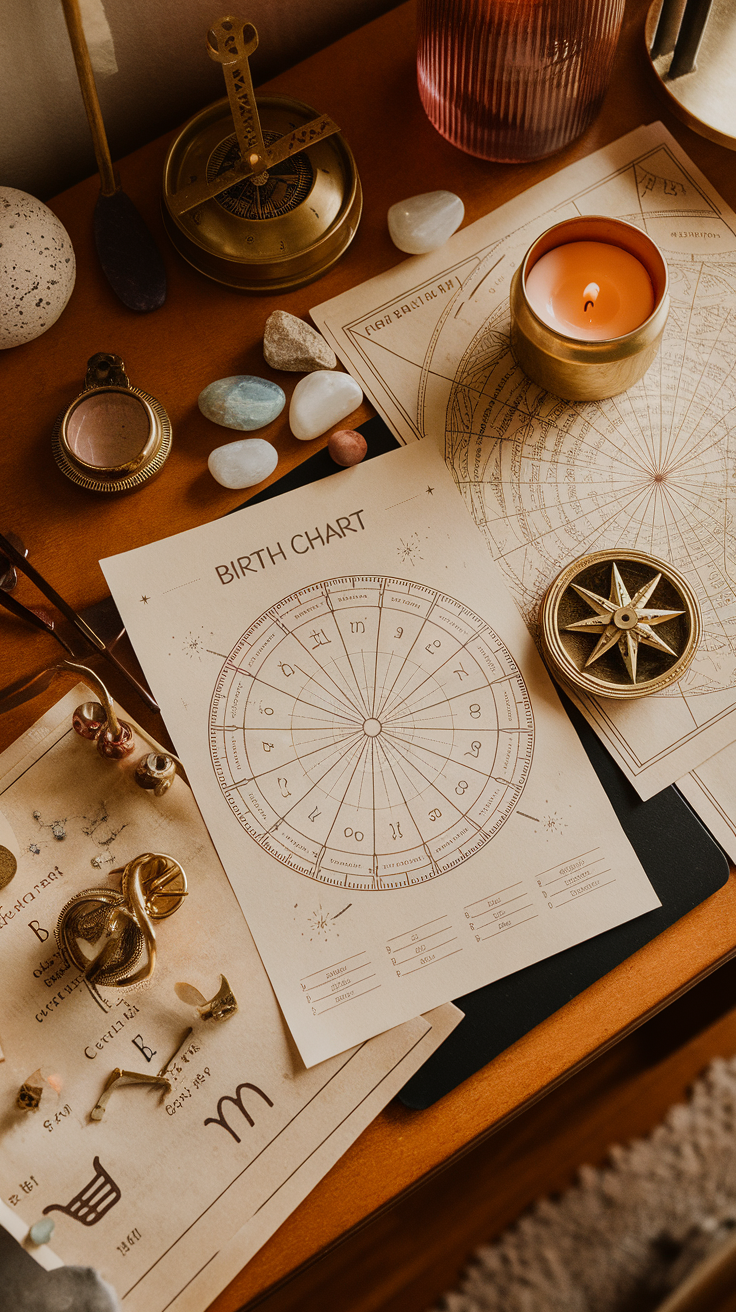
Understanding your birth chart is like unlocking a cosmic blueprint of your personality, strengths, challenges, and life path. While it may look like an overwhelming wheel of symbols and lines at first, learning to interpret your birth chart can be an enlightening journey into self-discovery.
In this guide, we’ll walk step by step through the key components of a birth chart and how to interpret them. Whether you’re new to astrology or deepening your practice, this article will help you get started.
What Is a Birth Chart?

A birth chart (also known as a natal chart) is a snapshot of the sky at the exact moment and location of your birth. It maps out where the Sun, Moon, and planets were positioned, offering insight into different aspects of your personality, emotions, relationships, and life experiences.
To generate your birth chart, you’ll need:
- Your date of birth
- Your time of birth (as exact as possible)
- Your place of birth
Once you have this information, you can create your chart using free online tools like Astro.com or Cafe Astrology.
The Core Elements of a Birth Chart

1. The Zodiac Signs
The 12 zodiac signs represent different personality traits and energies. Each planet in your chart will be in a zodiac sign, influencing how that planet’s energy expresses itself.
Here’s a quick overview of the zodiac signs:
- Aries (March 21 – April 19): Bold, energetic, impulsive
- Taurus (April 20 – May 20): Stable, sensual, persistent
- Gemini (May 21 – June 20): Curious, communicative, adaptable
- Cancer (June 21 – July 22): Emotional, intuitive, nurturing
- Leo (July 23 – August 22): Confident, creative, charismatic
- Virgo (August 23 – September 22): Detail-oriented, analytical, service-driven
- Libra (September 23 – October 22): Diplomatic, charming, balanced
- Scorpio (October 23 – November 21): Intense, secretive, passionate
- Sagittarius (November 22 – December 21): Adventurous, philosophical, optimistic
- Capricorn (December 22 – January 19): Disciplined, ambitious, practical
- Aquarius (January 20 – February 18): Innovative, independent, humanitarian
- Pisces (February 19 – March 20): Dreamy, intuitive, compassionate
2. The Planets and Their Meanings
Each planet governs a different area of life. The sign a planet is in colors how that planetary energy is expressed.
- Sun – Your core self, identity, and ego
- Moon – Your emotions, inner world, and subconscious
- Mercury – Communication, thinking, and learning style
- Venus – Love, beauty, and relationships
- Mars – Passion, drive, and how you take action
- Jupiter – Growth, luck, and expansion
- Saturn – Structure, responsibility, and lessons
- Uranus – Innovation, rebellion, and sudden changes
- Neptune – Dreams, spirituality, and illusions
- Pluto – Transformation, power, and deep healing
3. The Houses and Their Areas of Life
The birth chart is divided into 12 houses, each governing different aspects of life. The planets and signs in these houses reveal where specific energies play out.
- First House (Ascendant): Self-image, personality, first impressions
- Second House: Money, values, self-worth
- Third House: Communication, learning, siblings
- Fourth House: Home, family, emotional foundations
- Fifth House: Creativity, romance, pleasure
- Sixth House: Health, daily routines, service
- Seventh House: Relationships, partnerships, marriage
- Eighth House: Transformation, intimacy, shared resources
- Ninth House: Philosophy, higher education, travel
- Tenth House (Midheaven): Career, reputation, life purpose
- Eleventh House: Friendships, community, future goals
- Twelfth House: Spirituality, subconscious, hidden matters
4. The Aspects: Planetary Relationships
Aspects describe how planets interact with each other in your chart. The major aspects include:
- Conjunction (0°) – Two planets working together, amplifying their energies
- Sextile (60°) – Harmonious, opportunities for growth
- Square (90°) – Tension, challenges, but also potential growth
- Trine (120°) – Natural talent, ease, and flow
- Opposition (180°) – Polarized energy, balance needed
How to Read Your Birth Chart Step by Step

- Find Your Sun, Moon, and Rising Signs – These are the three most important placements.
- Look at the Houses – See which areas of life your planets are influencing.
- Interpret Planetary Placements – Each planet’s sign and house placement tell a story.
- Analyze Aspects – Note any strong connections between planets.
- Synthesize the Information – Look at the chart holistically for patterns and themes.

Reading your birth chart is a deeply personal and insightful practice. Start with the basics, and over time, you’ll begin to see the intricate layers of astrology unfold. Your birth chart is a guide—not a fixed fate—so use it as a tool for self-awareness and growth.


Leave a Reply